
Can Security Guards Wear Body Cameras in Illinois? Recording Laws Explained
Before wearing a body camera on duty, it’s important to understand Illinois security guard body camera laws. Body cameras are becoming a popular piece of equipment for private security officers. Some security companies require their officers to wear them, while other guards purchase their own cameras, hoping that having a video recording of an incident will protect them against false accusations.
That sounds like a pretty good idea, doesn’t it?
Well, not so fast.
A body camera could provide valuable evidence if you’re involved in a confrontation, accused of misconduct, or required to explain what happened during an incident. But that same camera could also create serious legal problems if you don’t understand Illinois recording laws.
Here’s something every Illinois security officer needs to understand: Recording video and recording audio are two very different things under Illinois law.
And starting January 1, 2027, a new Illinois law will create additional restrictions on certain recordings inside courthouses.
So, let’s examine what Illinois law actually says, how these laws apply to private security officers, and what you should know before switching on your body camera.
Table of Contents
Illinois security guard body camera laws: Can guards legally wear them?
Generally, yes. Illinois does not have a statewide law that categorically prohibits ordinary private security officers from wearing body cameras.
However, being allowed to wear a camera and being legally permitted to record a particular person or conversation are not necessarily the same thing.
There’s a difference between possessing recording equipment and using that equipment in a way that violates someone’s privacy.
For example, a security officer patrolling a shopping center might be authorized by the employer and property owner to record activities in public-facing areas. But that doesn’t mean the officer can walk into a restroom, activate the camera, and record everyone inside.
Nor does it mean the guard can secretly record a private conversation simply because the camera is attached to a uniform.
Security officers must consider several things before recording:
- Illinois laws governing audio recording and eavesdropping.
- Laws restricting unauthorized video recording in certain locations.
- Property owners’ rules and client agreements.
- Employer policies governing body cameras.
- Court orders or special restrictions that apply to particular facilities.
Some restrictions come from state law. Others arise from an employer’s instructions, property permissions, or contractual responsibilities.
And that brings us to an important distinction.
Private Security Officers Are Not Police Officers
Illinois has a law called the Law Enforcement Officer-Worn Body Camera Act.
This law establishes requirements for law enforcement agencies and the body cameras worn by their officers. It addresses matters such as recording procedures, equipment, storage, and the handling of recordings.
But here’s the important part.
If you’re an ordinary private security guard, those police-specific requirements generally do not apply to you simply because you wear a body camera.
The Act defines the law enforcement officers and agencies it covers. An ordinary private security employee is not automatically included within those definitions.
Just because a police officer is authorized to record something doesn’t automatically mean a private security guard has the same authority.
Your uniform doesn’t change that. Neither does your badge.
And purchasing an expensive body camera certainly doesn’t turn you into a police officer.
Private security personnel must comply with the laws that apply to their own activities, along with any lawful employer and client policies.
This is especially important when companies adopt police-style body camera procedures without considering whether those procedures are appropriate for private security operations.
When Can Security Guards Record Video in Illinois?
Let’s start with video recording without sound.
Imagine you’re working security at a shopping center. You’re patrolling the parking lot, and your body camera records customers walking to their vehicles, people entering stores, and cars moving through the property.
Is that recording illegal?
Generally, recording ordinary activities openly visible in public-facing areas is less likely to violate someone’s reasonable expectation of privacy. But the circumstances matter, and other laws or restrictions may still apply.
Think about it.
If you’re walking through a shopping center parking lot, other customers can see you. Employees can see you. The property may already have security cameras recording the area.
Most ordinary activities taking place openly in such locations aren’t private in the same way activities inside someone’s home or a changing room would be.
However, a location being accessible to the public doesn’t automatically give a security officer unlimited authority to record whatever happens there.
The property owner may establish recording restrictions. A healthcare facility may have confidentiality obligations. A courthouse may have special rules. Recording audio introduces additional legal considerations.
There are also locations where Illinois law specifically restricts unauthorized video recording.
Places Where Illinois Restricts Video Recording
Under 720 ILCS 5/26-4, Unauthorized Video Recording and Live Video Transmission, Illinois prohibits certain unauthorized recordings of people in locations including:
- Restrooms.
- Locker rooms.
- Changing rooms.
- Tanning beds and tanning salons.
- Hotel bedrooms.
- Another person’s residence.
The statute also addresses certain recordings of a person’s intimate body parts and the placement of recording equipment in specified private locations. It includes particular exceptions, so the exact statutory provisions matter.
Here’s an example.
You’re working security at an apartment complex. A tenant reports suspicious activity inside the building.
Does that give you permission to walk into someone’s apartment with your body camera recording?
No. A tenant’s home has legal protections that are different from those applicable to an ordinary public corridor. Your assignment to provide security does not, by itself, authorize you to disregard those protections.
And here’s another consideration: Even when recording is otherwise lawful, your employer or client may restrict recording in particular areas.
A shopping center, hospital, warehouse, or residential community may have different operational requirements.
Know the rules before you’re faced with an incident, not after someone files a complaint.
Can Illinois Security Guards Record Audio Without Consent?
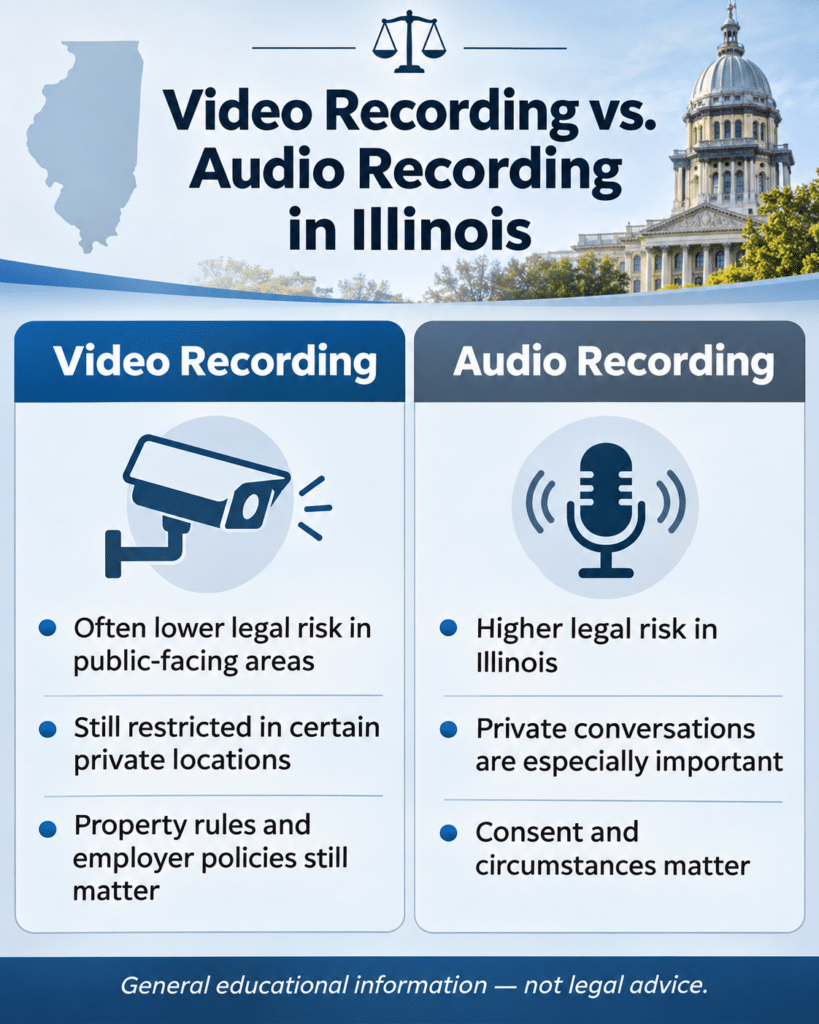
Now we’re getting into an area where security officers can find themselves in trouble.
Illinois has an eavesdropping law that regulates certain audio recordings. You’ll frequently hear people describe Illinois as an all-party consent state.
That’s a useful warning, but it doesn’t tell the entire story.
The Illinois Eavesdropping Act, 720 ILCS 5/14, distinguishes private conversations from conversations where a legally justified expectation of privacy doesn’t exist.
The statute also addresses something called surreptitious recording.
Surreptitious is a fancy legal word that essentially means doing something secretly, through concealment or deception.
Why does this matter?
Because Illinois law generally prohibits intentionally and surreptitiously recording a private conversation without the consent required by the statute. The restrictions can apply even when the person making the recording participates in that conversation.
However, that doesn’t mean recording every conversation that can be heard in public automatically violates the law.
Let’s examine two examples.
Example 1: Recording a Loud Public Argument
Imagine you’re working security at a grocery store.
Two customers begin arguing near the main entrance. They’re yelling, using profanity, and creating a disturbance. Everyone nearby can hear what they’re saying.
You activate your body camera and openly record the incident, including the audio.
Is that automatically illegal because you didn’t get permission from both customers?
Not necessarily.
The law’s definition of a private conversation considers whether the circumstances reasonably justify an expectation that the conversation will remain private.
A loud argument taking place openly in front of customers may not qualify as a private conversation.
That distinction can matter when evaluating whether a recording violates the eavesdropping statute.
But don’t interpret this example as blanket permission to record every conversation inside a business. The facts, the manner of recording, and any other applicable restrictions still matter.
Example 2: Secretly Recording a Private Conversation
Now imagine you’re working security in an office building.
Two employees are quietly discussing a personal matter in a secluded area of the lobby. They reasonably believe their conversation is private.
You decide to activate your body camera microphone without telling them because you’re curious about what they’re discussing.
Could that be illegal?
Absolutely. Under the circumstances, secretly recording that conversation without the required consent could violate Illinois eavesdropping law.
Notice something about these examples.
Both situations occurred in areas where other people might be present.
But the legal analysis can be different because the circumstances surrounding the conversations are different.
A conversation doesn’t automatically lose its private character just because it occurs somewhere other than a person’s home.
That’s why a security officer needs to understand more than whether a location is technically open to the public.
Does Wearing a Visible Body Camera Mean Everyone Consents to Recording?
Here’s another common misunderstanding.
Some officers believe that wearing a camera openly means everyone around them has automatically consented to having their conversations recorded.
That’s not a safe assumption.
A visible body camera may make the recording less secretive, depending on the circumstances. But a person seeing a camera doesn’t necessarily know that its microphone is switched on.
Many body cameras can record video with the audio disabled. Others may have recording indicators that aren’t particularly noticeable.
And even if someone knows you’re wearing a camera, that doesn’t necessarily establish legally sufficient consent to every recording.
The safest approach is to follow a properly developed employer policy that addresses when recording is permitted, when notice is required, and how consent should be obtained when necessary.
What About Signs Warning People That Recording Is Taking Place?
Businesses sometimes display signs advising customers, visitors, and employees that audio or video recording may occur.
Those signs can be useful.
They help communicate that recording equipment is being used, and notice may be relevant when evaluating the circumstances of a recording.
But a sign isn’t a magical piece of paper that eliminates every privacy law.
Posting a surveillance notice doesn’t give employees unrestricted permission to record private conversations, enter protected spaces, or ignore other legal requirements.
A security company should have an appropriate policy covering recording notices, audio activation, and locations where recording is restricted.
And security officers should understand that policy before being issued a body camera.
New Illinois Courthouse Recording Law Effective January 1, 2027
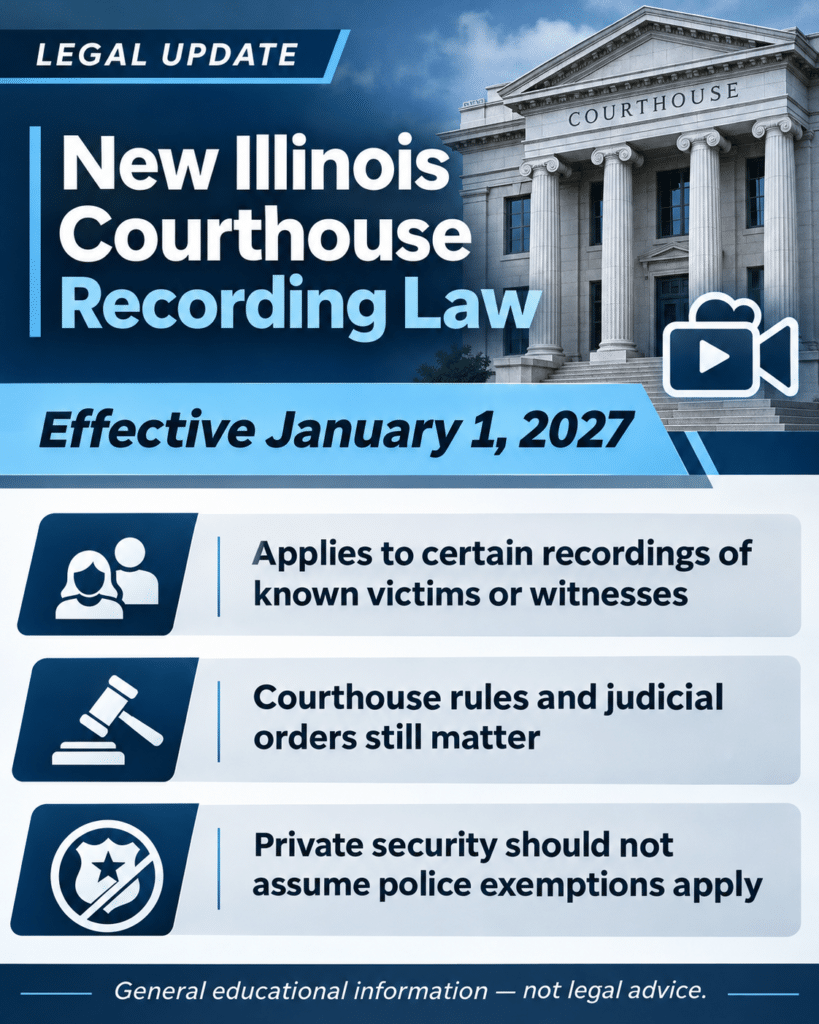
Now let’s discuss a significant change coming to Illinois.
Effective January 1, 2027, Illinois Public Act 104-0750 amends the state’s unauthorized video recording statute.
The law adds restrictions concerning the unauthorized recording or livestreaming of a person whom the individual making the recording knows to be a victim or witness inside a courthouse.
Under the new provision, recording can be prohibited without the consent specified in the statute, which may come from:
- The person being recorded.
- The presiding judge.
- An entity responsible for providing law enforcement or courthouse security.
Any such permission must be consistent with applicable judicial orders. A person’s individual consent cannot override a court order prohibiting recording.
Violating the new subsection can constitute a Class A misdemeanor.
Now, before anyone starts panicking, let’s clarify something.
This law doesn’t mean every video recording inside every courthouse automatically becomes a criminal offense under the new provision.
The restriction concerns particular recordings involving people known to be victims or witnesses, and the legislation contains defined permissions and exemptions.
Also, the statute’s definition of a courthouse includes local, county, and state facilities where court proceedings are held and court functions occur.
What Does the New Law Mean for Private Security Guards?
The legislation specifically states that the new subsection does not apply to video captured by courthouse security cameras or body cameras worn by law enforcement officers.
Notice the wording: law enforcement officers.
An ordinary private security guard doesn’t automatically qualify for that body-camera exemption.
Does that mean private security officers can never use body cameras inside courthouses?
No. That’s not what the law says.
But it does mean a security officer should not assume the law enforcement exemption automatically applies simply because the officer is providing security.
There may be authorized courthouse security operations, permissions under the statute, and other applicable rules. Those circumstances need to be evaluated properly.
Courts also have existing restrictions concerning recording proceedings, and judges can issue orders limiting photography and recording.
If your security assignment takes you into a courthouse, make sure you know the rules before leaving your body camera recording.
And if you aren’t sure, get clarification from your supervisor and the appropriate courthouse authority.
An officer should not have to guess about whether recording is permitted during an assignment.
Body Camera Policies Every Security Company Should Consider
So far, we’ve discussed several Illinois laws that may affect security officers using body cameras.
But there is another issue that deserves attention.
What does your security company’s body camera policy actually say?
Does your employer require recording during every interaction? Are you permitted to turn off the microphone? What happens when you’re assigned to an area where recording is restricted?
And who is responsible for preserving the footage?
If nobody can answer those questions, the company has some work to do.
Not every recommendation below is a specific statewide legal requirement for private security companies. These are operational practices companies should consider when developing a recording policy with appropriate legal guidance.
1. Establish When Cameras Should Be Activated
Security officers should understand when their employer expects them to record.
For example, a company might establish procedures for documenting confrontations, disturbances, threats, or other incidents where recording is lawful and appropriate.
The policy should also explain when recording must stop and what to do if a situation involves protected private spaces or private conversations.
Officers shouldn’t have to invent their own procedures while responding to a disturbance.
2. Establish Separate Rules for Audio Recording
This is especially important in Illinois.
A body camera that records video and audio may create legal considerations that don’t exist when capturing silent video alone.
Companies should determine when audio recording is lawful, what notification procedures should be used, and whether officers may or must disable audio in particular circumstances.
If the camera doesn’t allow officers to disable audio separately, that equipment limitation should be considered when developing the company’s procedures.
3. Protect the Recordings
Body camera footage can contain sensitive information.
Depending on the assignment, recordings might capture customers, employees, patients, residents, suspects, witnesses, or other people who didn’t expect the footage to become public.
Security companies should establish appropriate safeguards for storing, accessing, sharing, and deleting recordings.
This includes deciding who may review footage and how access will be documented.
A guard’s personal social media account is not an evidence management system.
4. Preserve Evidence Properly
Imagine a security officer records an altercation between two customers.
One customer later alleges that the guard used excessive force. The recording may help establish what actually happened.
But what if the officer deletes part of the recording? What if the original file is overwritten? What if several employees have access to the footage and nobody can explain who handled it?
Suddenly, a recording that might have been useful evidence becomes a problem.
A security company’s policy should address evidence preservation, retention, access controls, documentation, and any litigation or investigative holds.
When footage may be relevant to an investigation or legal proceeding, it should be preserved according to applicable legal obligations and company procedures.
Don’t edit, delete, or publish incident footage on your own initiative.
5. Train Officers on the Policy
A body camera policy isn’t particularly useful if nobody understands it.
Security officers should receive training addressing lawful recording, privacy restrictions, audio recording, reporting requirements, evidence preservation, and the company’s procedures.
The policies should also be reviewed when relevant laws or operational requirements change.
If you supervise or manage security officers, consider how these issues are addressed within your company’s training program.
For officers beginning their careers, the Academy of Security Training’s Illinois Unarmed Security 20-Hour Certification course covers subjects including civil and criminal liability, civil rights, and the legal responsibilities of Illinois security officers.
Those foundational subjects are important whether or not your employer issues body cameras.
Five Things Every Illinois Security Guard Should Remember
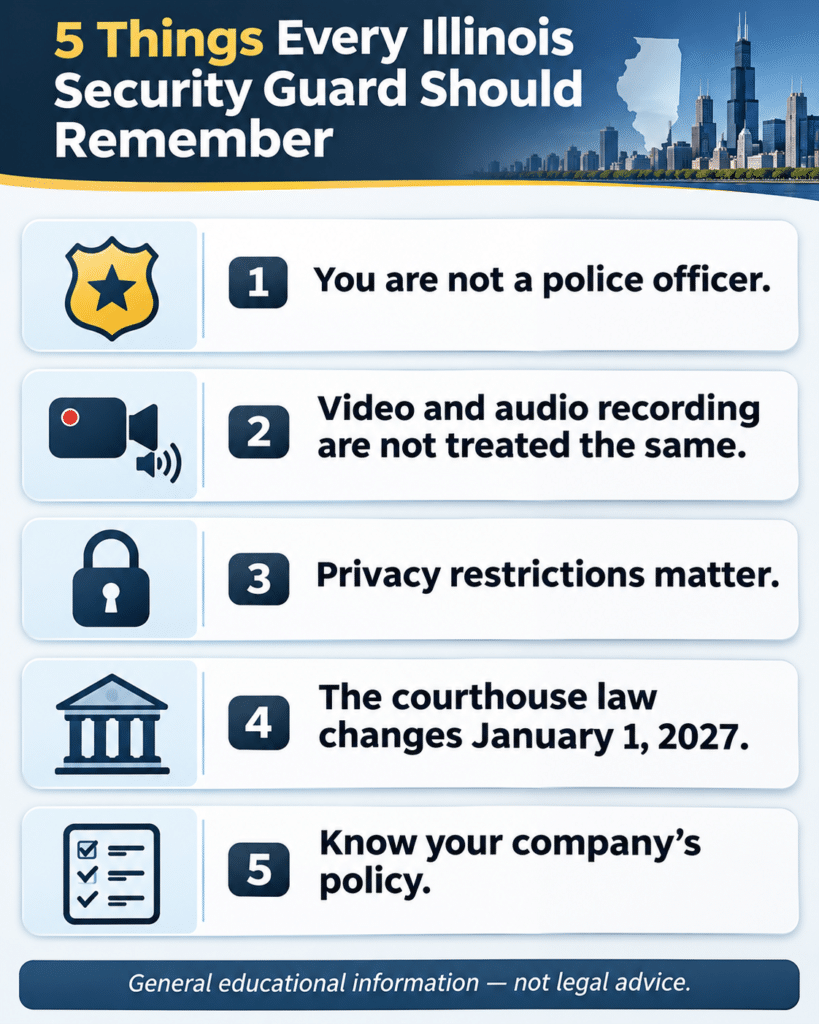
We’ve covered several laws, restrictions, and operational considerations.
This subject could easily become a much longer discussion, particularly when individual assignments and specific recording situations are involved.
But if you’re an Illinois security officer who wears a body camera, there are five things I want you to remember.
1. You’re not a police officer.
Don’t assume the rules governing police body cameras automatically apply to private security personnel.
2. Video recording and audio recording aren’t legally identical.
Recording an ordinary activity in a public-facing area can raise different legal questions from secretly recording a private conversation.
3. Privacy restrictions matter.
Your security assignment doesn’t automatically authorize you to record people in protected private spaces.
4. The courthouse law changes January 1, 2027.
The new provision restricts certain unauthorized recordings of known victims and witnesses inside courthouses. Ordinary private security officers shouldn’t automatically assume that the law enforcement body-camera exemption applies to them.
5. Know your company’s policy.
Understand when you’re authorized to record, when the microphone may be used, when recording should stop, and how recordings must be handled.
And here’s one more thing worth remembering.
Don’t post body camera footage on social media simply because you think the video is interesting or might generate a few thousand views.
That footage may contain confidential information, involve someone’s privacy, or become relevant to an investigation.
Protecting evidence is more important than collecting likes.
Frequently Asked Questions About Illinois Security Guard Body Cameras
Are body cameras required for private security guards in Illinois?
The statewide Law Enforcement Officer-Worn Body Camera Act imposes requirements on covered law enforcement agencies, not ordinary private security companies merely because they employ guards.
A private security employer may nevertheless require body cameras as part of its own procedures or client agreements, subject to applicable law.
Can a security guard record someone in a shopping center?
Recording ordinary activities openly visible in a shopping center’s public-facing areas is generally less likely to raise the same privacy issues as recording someone in a protected private space.
However, property rules, employer authorization, audio recording restrictions, and the circumstances of the recording still matter.
Is Illinois a two-party consent state for audio recording?
Illinois is commonly described as an all-party consent state, but the actual eavesdropping statute contains important qualifications involving private conversations and surreptitious recording.
For covered private conversations, recording without the required consent can violate the law even when the person recording is a participant.
Can security guards record audio during an argument?
Possibly, depending on the circumstances.
A loud argument heard openly by everyone nearby may not qualify as a private conversation under the eavesdropping statute. That doesn’t mean every argument can be recorded without restriction.
Security officers should follow applicable law and their employer’s lawful recording procedures.
Can security guards turn off the microphone on their body cameras?
That depends on the equipment and the employer’s policy.
A company should develop audio recording procedures that comply with Illinois law. Security officers should not assume their employer’s instructions automatically make an otherwise unlawful recording permissible.
Can security guards wear body cameras inside courthouses?
It depends on the assignment, the applicable courthouse rules, any judicial orders, and the recording itself.
Beginning January 1, 2027, Illinois law imposes additional restrictions concerning certain recordings of known victims or witnesses inside courthouses. The new provision expressly addresses courthouse security cameras and law enforcement body cameras, but it does not automatically exempt ordinary private security body cameras.
Can a security guard upload body camera footage to social media?
Officers should not independently upload work-related body camera footage without proper authorization.
Depending on the content and circumstances, disclosure may create privacy, employment, contractual, or legal issues. Recordings connected to an incident may also need to be preserved as evidence.
Final Thoughts
Body cameras can be useful tools for security officers.
They can document incidents, help clarify what happened during confrontations, and provide evidence when someone’s version of events is disputed.
But a camera doesn’t automatically protect you from legal liability. Used improperly, it can create an entirely different set of problems.
Illinois security guards need to understand the difference between video and audio recording, recognize situations involving a reasonable expectation of privacy, and follow applicable recording laws and employer policies.
And with the new courthouse recording provision taking effect on January 1, 2027, this is a good time for security companies to review their procedures.
If you’re wearing a body camera and don’t know whether you’re allowed to record audio, ask your supervisor. If the company’s policy isn’t clear, ask for clarification in writing.
There’s nothing wrong with wanting a recording that protects you from a false accusation.
Just make sure that the way you obtain that recording doesn’t become the reason you’re facing an accusation in the first place.
Legal disclaimer: This article provides general educational information, not legal advice. Illinois statutes, court rules, and judicial interpretations can change. The legality of a particular recording depends on its circumstances. Security companies should consult qualified Illinois legal counsel when establishing or revising recording policies.
Last reviewed: November 10, 2026.

